
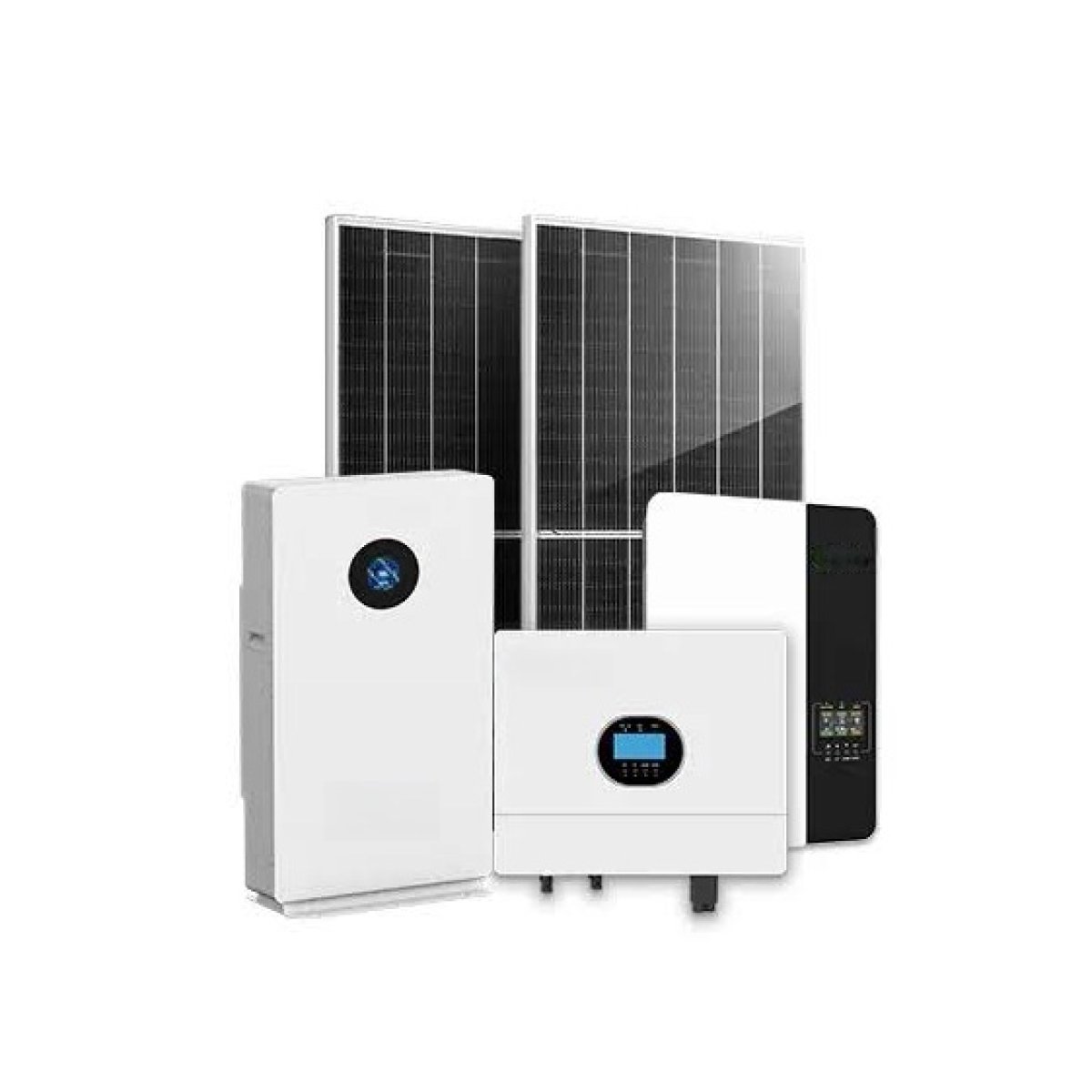
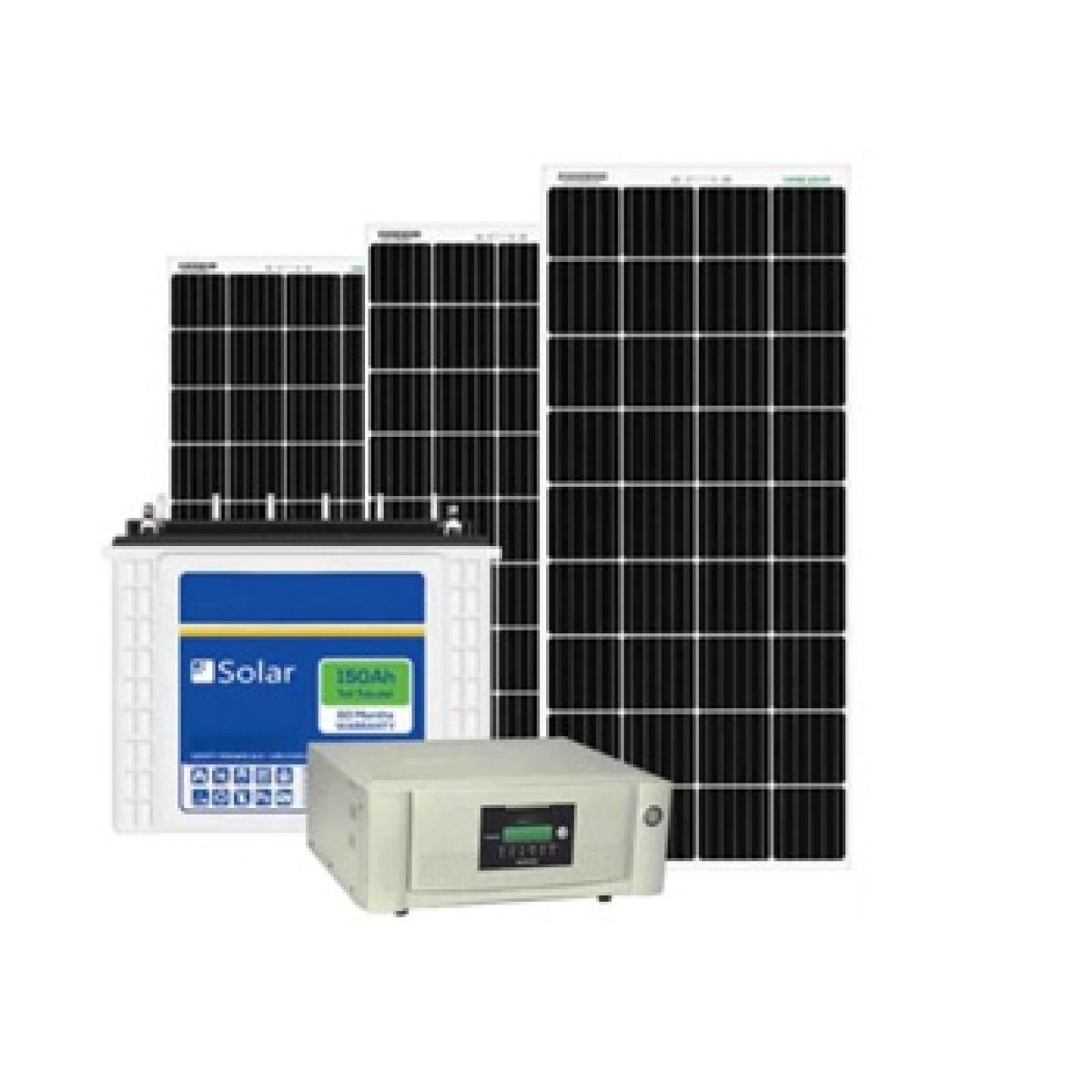
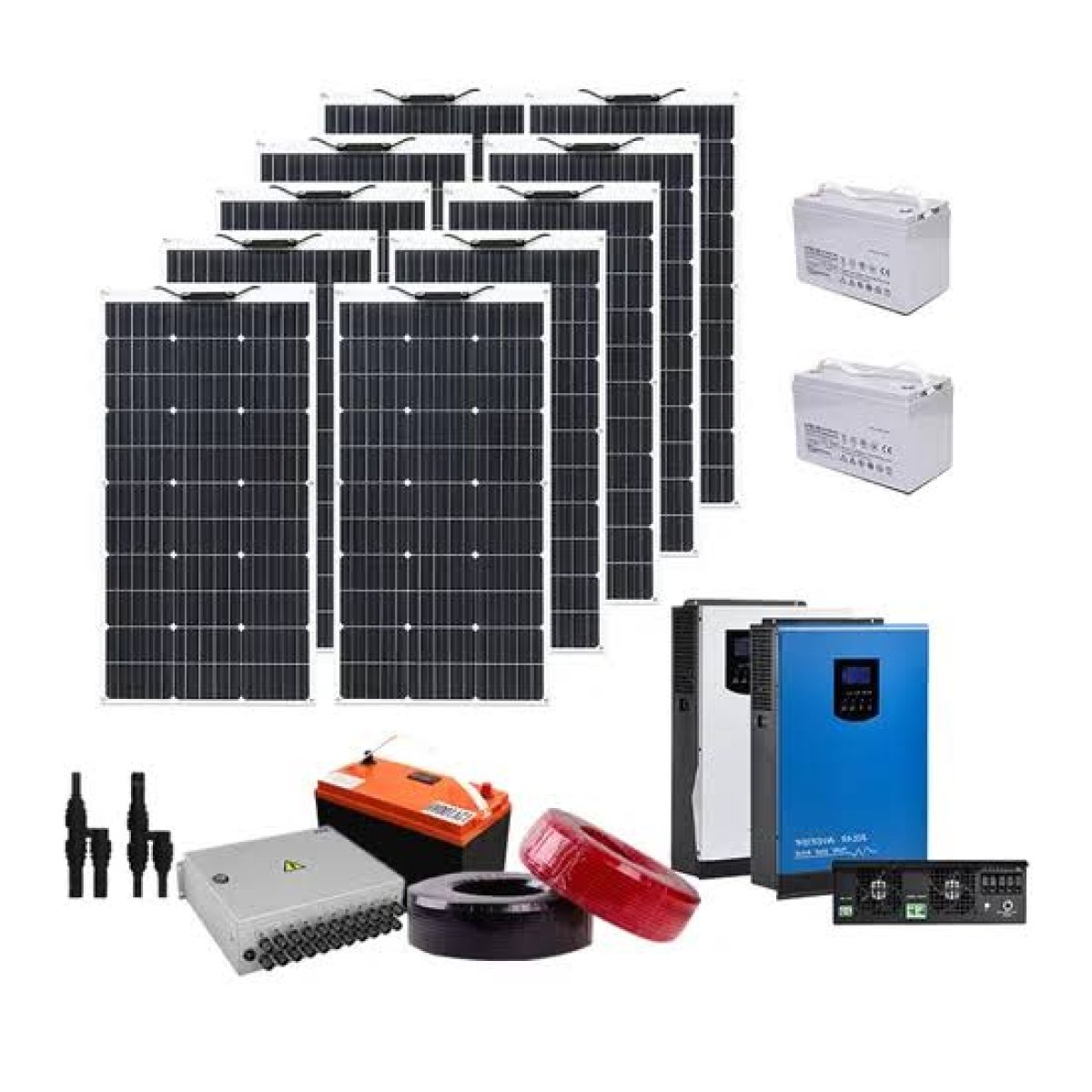
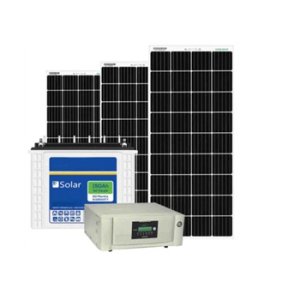
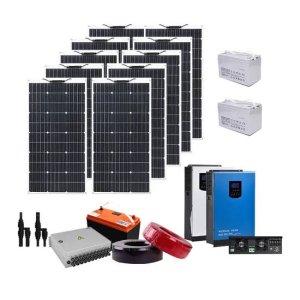
An Off-Grid (or Stand-Alone) power system is a fully autonomous photovoltaic (PV) generation network that operates completely independent of the municipal utility grid. Because it has no connection to a public power line, an off-grid system relies on a dedicated battery storage bank to save daytime solar energy for use at night or during overcast weather, requiring precise load sizing and auxiliary backup generation to guarantee continuous power security.
1. System Architecture & Component Breakdown
Unlike grid-tied systems that use the public grid as an infinite virtual battery, an off-grid system must function as its own micro-utility. Every watt generated must be immediately consumed, stored, or safely dissipated.
Photovoltaic (PV) Array: Captures solar irradiance and generates Direct Current (DC) electricity, sized not just to power the daytime load, but to simultaneously refill the battery bank for nighttime use.
Solar Charge Controller: The critical regulator positioned between the panels and the batteries. It prevents the solar array from overcharging the batteries during peak sun hours and stops power from draining backward from the batteries to the panels at night.
Battery Storage Bank: The heart of the system. It stores excess daytime DC generation. Modern off-grid systems predominantly use Lithium Iron Phosphate ($LiFePO_4$) batteries due to their deep depth of discharge ($DoD$) and long cycle life, replacing legacy flooded lead-acid batteries.
Off-Grid Inverter: Converts the DC power stored in the battery bank into stable Alternating Current (AC) power ($120\text{V}/240\text{V}$) to run standard household appliances and electronics.
2. Charge Controller Technologies: PWM vs. MPPT
Because off-grid systems rely on limited resource pools, maximizing energy harvesting efficiency through the charge controller is paramount.
PWM (Pulse Width Modulation)
A legacy, low-cost option. A PWM controller acts as a rapid electronic switch between the solar panels and the battery.
Limitation: It forces the solar panels to operate at the exact voltage of the battery bank. Because panels typically have a much higher optimal operating voltage than a battery, forcing the voltage down causes the system to lose up to 20% to 30% of the panel's potential power capacity.
MPPT (Maximum Power Point Tracking)
The modern industrial standard. An MPPT controller utilizes an electronic algorithm to continuously track and calculate the absolute maximum power point of the solar panels:
It decouples the panel voltage from the battery voltage. If the panels are running at $60\text{V}$ and the battery is at $24\text{V}$, the MPPT controller down-converts the excess voltage and safely converts it into extra current into the battery. This ensures the solar array always operates at its peak thermodynamic efficiency, yielding up to $30\%$ more energy than PWM.
3. System Sizing, Autonomy, and Backup
Engineering an off-grid system requires strict mathematical modeling. While a grid-tied system can underproduce without consequence, an under-sized off-grid system results in an immediate blackout.
Days of Autonomy: The number of consecutive days an off-grid system can run entirely off its battery bank without receiving any solar input (typically during heavy storms or winter blizzards). Most systems are engineered for $2$ to $3$ days of autonomy.
The Generator Interlock (Inverter-Charger): Because building a solar array large enough to handle a worst-case $7$-day storm is cost-prohibitive, professional off-grid systems incorporate a gas, diesel, or propane Backup Generator. Modern off-grid inverters include an integrated battery charger and an automatic transfer switch (ATS). When the battery bank drops to a critical state of charge (e.g., $20\%$), the inverter sends a dry-contact signal to auto-start the generator, which directly powers the building while rapidly charging the batteries back to safety.