
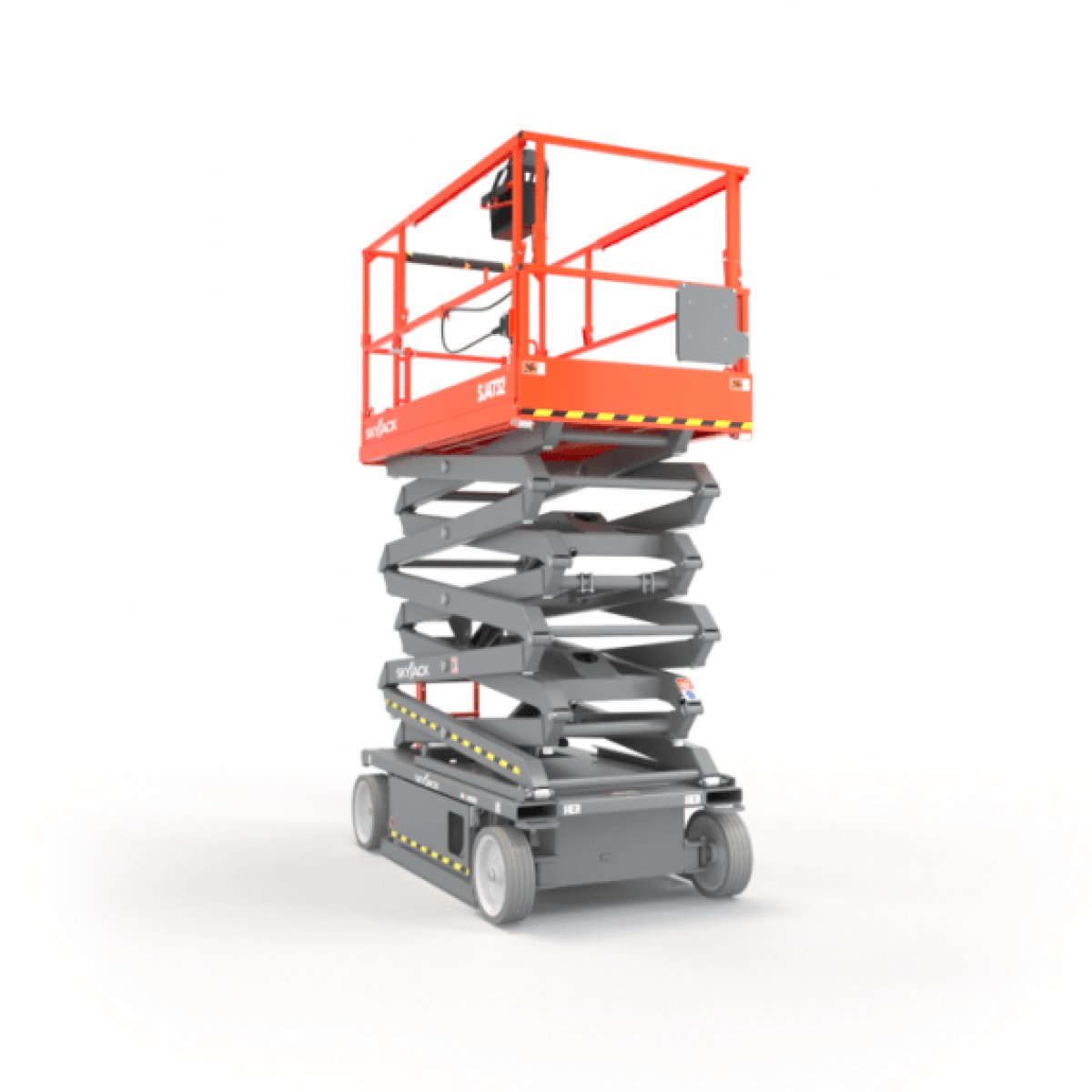
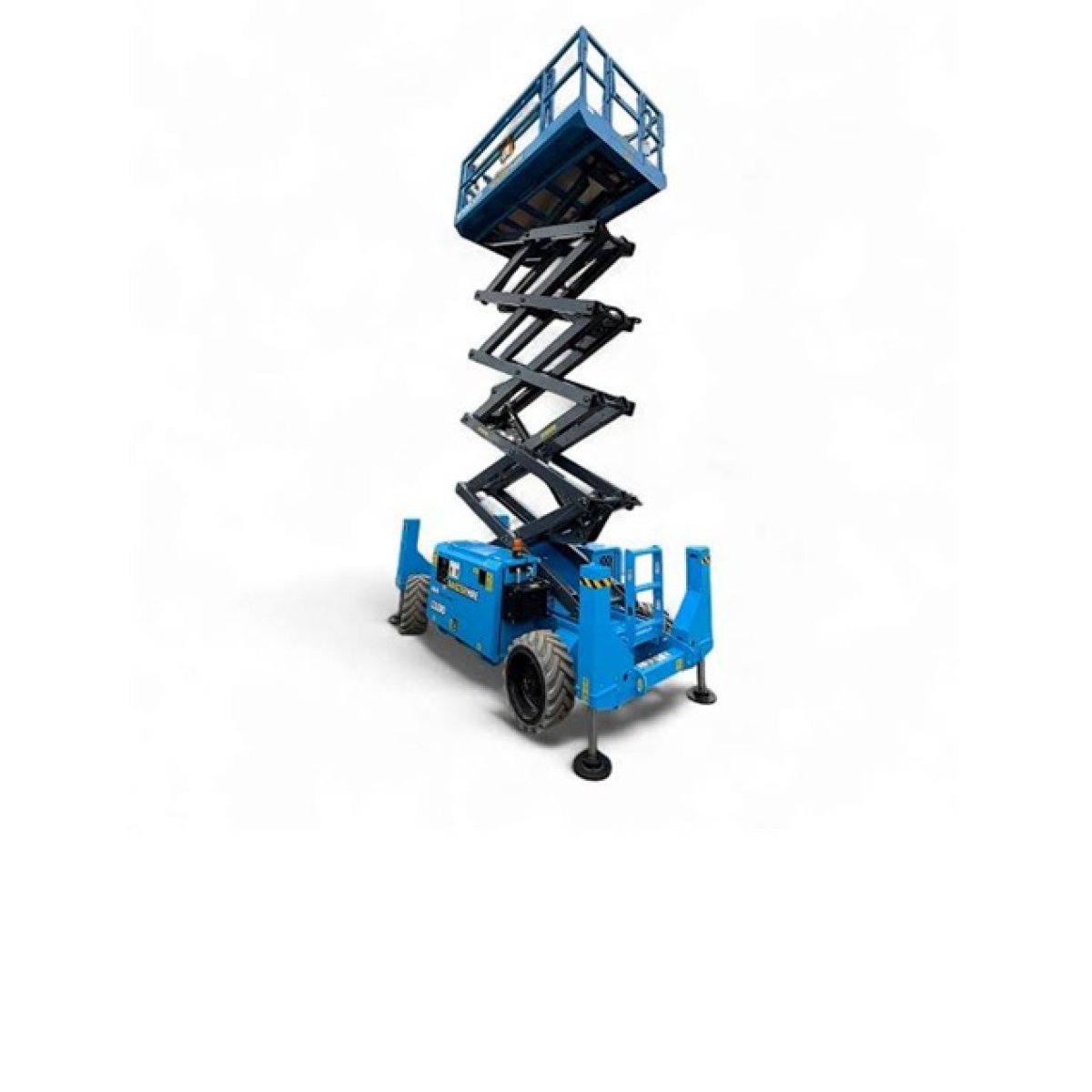
A Scissor Lift is a heavy-duty, highly stable mechanical lifting platform utilized to raise personnel, tools, and industrial materials vertically to elevated work areas. Characterized by its signature cross-braced, pantograph leg assembly, the lift operates as a mobile scaffold. As hydraulic pistons or electric actuators push against these linked structural braces, the mechanism extends vertically like an accordion, providing an exceptionally rigid overhead work platform designed to support high material capacities.
1. Mechanical Principles & The Scissor Mechanism
The defining engineering feature of a scissor lift is its geometric lifting framework, structurally known as a pantograph or scissor mechanism.
Geometric Advantage: The lift consists of interlocking, symmetric steel folding arms pinned together in an alternating "X" pattern. A series of high-capacity hydraulic cylinders or heavy-duty electric screw jacks are positioned horizontally or diagonally between the bottom tiers of the scissor legs.
The Vertical Translation: When the hydraulic pump forces fluid into the cylinders, the pistons push outward against the lower scissor pins. This horizontal force is converted by the cross-braced geometry into a vertical lifting force:
As the angle ($\theta$) of the scissor arms increases, the platform rises straight up along a perfectly linear vertical axis. Because the weight of the platform is distributed evenly across four or more intersecting steel support pillars, scissor lifts offer significantly higher stability and weight capacities—often ranging from 250 kg to over 1,000 kg (550 lbs to 2,200+ lbs)—compared to single-mast boom lifts.
2. Core Operational Classifications
Scissor lifts are specifically engineered based on their intended working environment, primarily falling into two structural categories:Slab Scissor Lifts (Electric)
Engineered for flat, solid indoor concrete floors, such as those found in warehouses, factories, cleanrooms, and data centers.
Propulsion & Power: Driven by zero-emission electric motor arrays powered by deep-cycle AGM or Lithium-ion battery banks.
Design Traits: Equipped with solid, non-marking rubber tires to prevent floor scuffing. They feature a highly compact chassis designed to fit through standard office doorways and navigate tight warehouse racking aisles.
Rough Terrain Scissor Lifts (RT)
Engineered for rugged, uneven outdoor construction sites, energy fields, and infrastructure maintenance.
Propulsion & Power: Powered by high-torque internal combustion engines running on diesel, gasoline, or liquid propane (LPG), often paired with robust four-wheel-drive (4WD) drivetrains.
Design Traits: Equipped with heavy-duty, foam-filled, deep-tread tractor tires. They typically incorporate automated Hydraulic Outriggers (stabilizing legs) that extend from the chassis to physically level the entire machine on mud or gravel before the platform is permitted to lift.
3. Safety Controls & Structural Interlocks
Because scissor lifts operate as elevated work platforms carrying personnel alongside heavy power tools, they are governed by strict international safety regulations (such as ANSI A92 or EN 280).
The Pothole Protection System: On indoor slab lifts, a set of mechanical steel plates is mounted low along the chassis. The moment the platform rises a few feet, these plates automatically pivot downward close to the floor. If a wheel accidentally rolls into a hidden floor trench or pothole, the rigid steel plate hits the ground instantly, catching the weight of the machine and preventing a catastrophic sideways tip-over.
Tilt Sensor Interlocks: An integrated electronic tilt switch continuously calculates the gravity chassis angle. If the machine is resting on a slope that exceeds safe manufacturing tolerances (typically $1.5^\circ$ to $3^\circ$), an alarm blares, and the control system completely disables upward travel, allowing the operator only to lower the platform back to a safe baseline.
Descent Protection & Velocity Fuses: To prevent crushing hazards to ground personnel during platform lowering, modern scissor lifts feature a built-in descent delay or audible pulsing alarm. Furthermore, directly inside the hydraulic cylinders are integrated velocity fuses. If a hydraulic line snaps or experiences a sudden drop in pressure, the fuse slams shut instantly, mechanically locking the oil inside the cylinder and freezing the platform in mid-air to prevent a free-fall.