

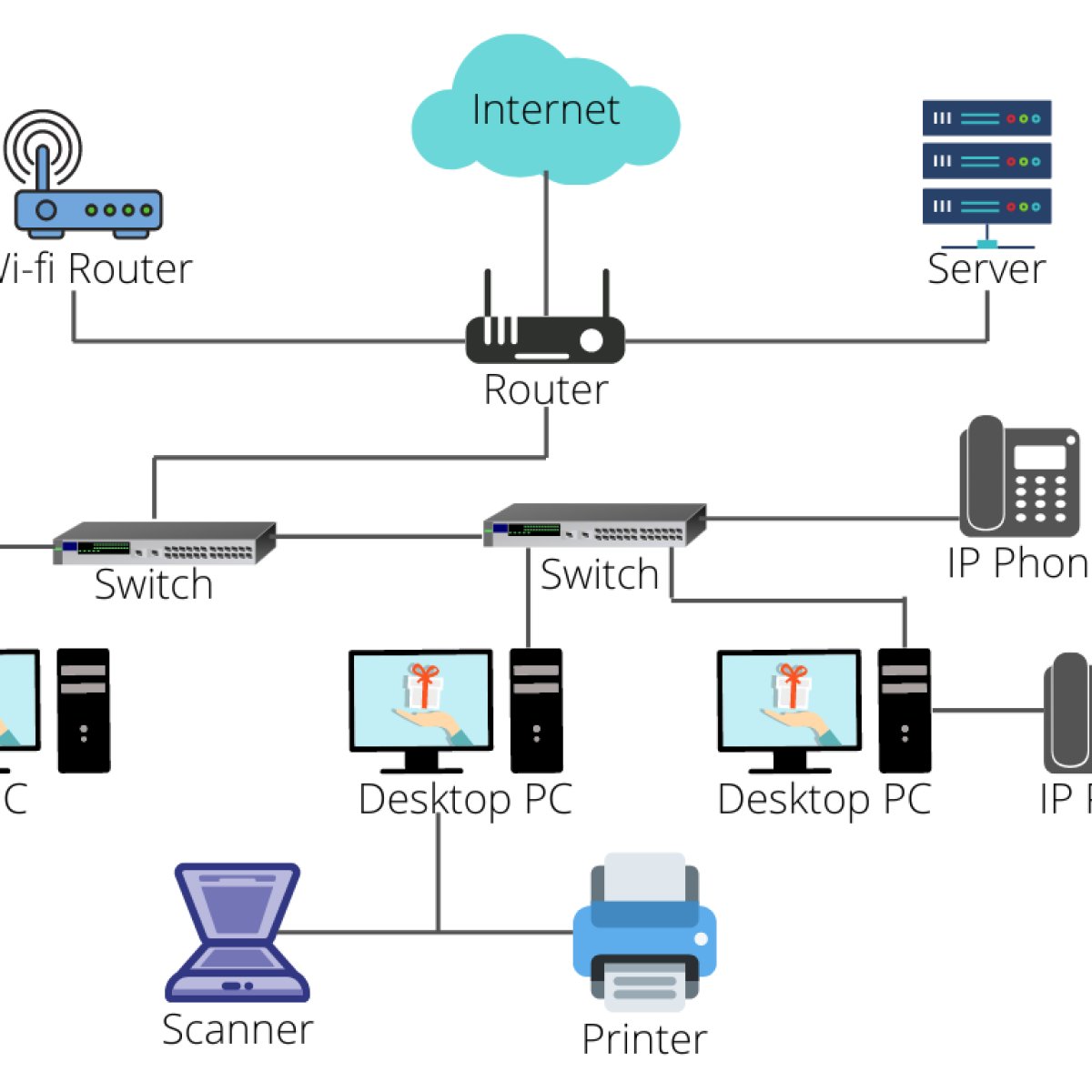


Network Infrastructure is the foundational framework of hardware, software, protocols, and transmission media that enables digital connectivity, data exchange, and communication across an organization. It acts as the digital highway system of modern enterprise, securely routing raw data packets between users, local devices (IoT, servers), and external cloud environments while ensuring high throughput and minimal latency.
1. Physical Hardware & Topological Architecture
The enterprise network is structured in a multi-layered design—traditionally a three-tier hierarchical model (Core, Distribution, Access)—to optimize traffic flow, isolate faults, and scale seamlessly.
The Access Layer (Edge): Where end-user devices (PCs, VoIP phones, IP cameras, wireless access points) interface directly with the network. This layer is dominated by Edge Switches supplying Power over Ethernet (PoE) to eliminate separate power lines for edge equipment.
The Distribution Layer (Aggregation): Acts as the boundary between the access layer and the core. It aggregates data streams from multiple access switches, enforces local security policies, handles routing between Virtual Local Area Networks (VLANs), and manages traffic filtering.
The Core Layer (Backbone): The high-speed structural spine of the network. It is designed to switch data packets as fast as possible without processing bottlenecks. Core routers and switches handle high-bandwidth trunk links, connecting distribution blocks to data centers and external internet service gateways.
2. Network Protocols & Traffic Management
To ensure that vast amounts of concurrent data reach their destinations without colliding or causing network gridlock, specialized protocols govern the infrastructure:Logical Segmentation (VLANs)
Through software configuration, a single physical switch network is carved into multiple distinct Virtual Local Area Networks (VLANs) (e.g., separating administrative traffic from guest Wi-Fi and IoT building systems). This controls broadcast domains, drastically reduces background network chatter, and walls off sensitive data zones.Quality of Service (QoS)
QoS algorithms classify and prioritize data packets based on application sensitivity. Time-critical traffic—such as live video conferencing or VoIP voice packets—is moved to the front of the transmission queue, while non-real-time data like email syncing or file downloads are briefly throttled, ensuring crystal-clear communication during high-congestion periods.Spanning Tree Protocol (STP / RSTP)
To prevent network failure, engineers build physical loops (redundant backup cables between switches). However, left unchecked, loops cause broadcast storms that instantly crash a network. Spanning Tree Protocol (IEEE 802.1D/w) dynamically detects these loops, logically disables the redundant paths, and automatically opens them back up within milliseconds if a primary cable is severed.3. Modern Infrastructure Evolution: SDN & SD-WAN
Traditional infrastructure required network engineers to manually log into individual routers and switches via command-line interfaces to adjust configurations. Modern architecture has shifted toward Software-Defined Networking (SDN):
Control and Data Plane Separation: SDN abstracts the intelligence (Control Plane) away from the physical forwarding hardware (Data Plane). A centralized software controller manages the entire network topology as a single programmable entity, automating device provisioning and security configurations on the fly.
SD-WAN (Wide Area Networking): For enterprises managing multiple geographic branches or data centers, SD-WAN dynamically routes traffic across different physical WAN connections (such as private MPLS circuits, direct commercial broadband, or 5G cellular link networks) based on current line quality and cost metrics, optimizing application performance across the globe.